
Wedding Roles Explained: Who Does What at a Wedding?
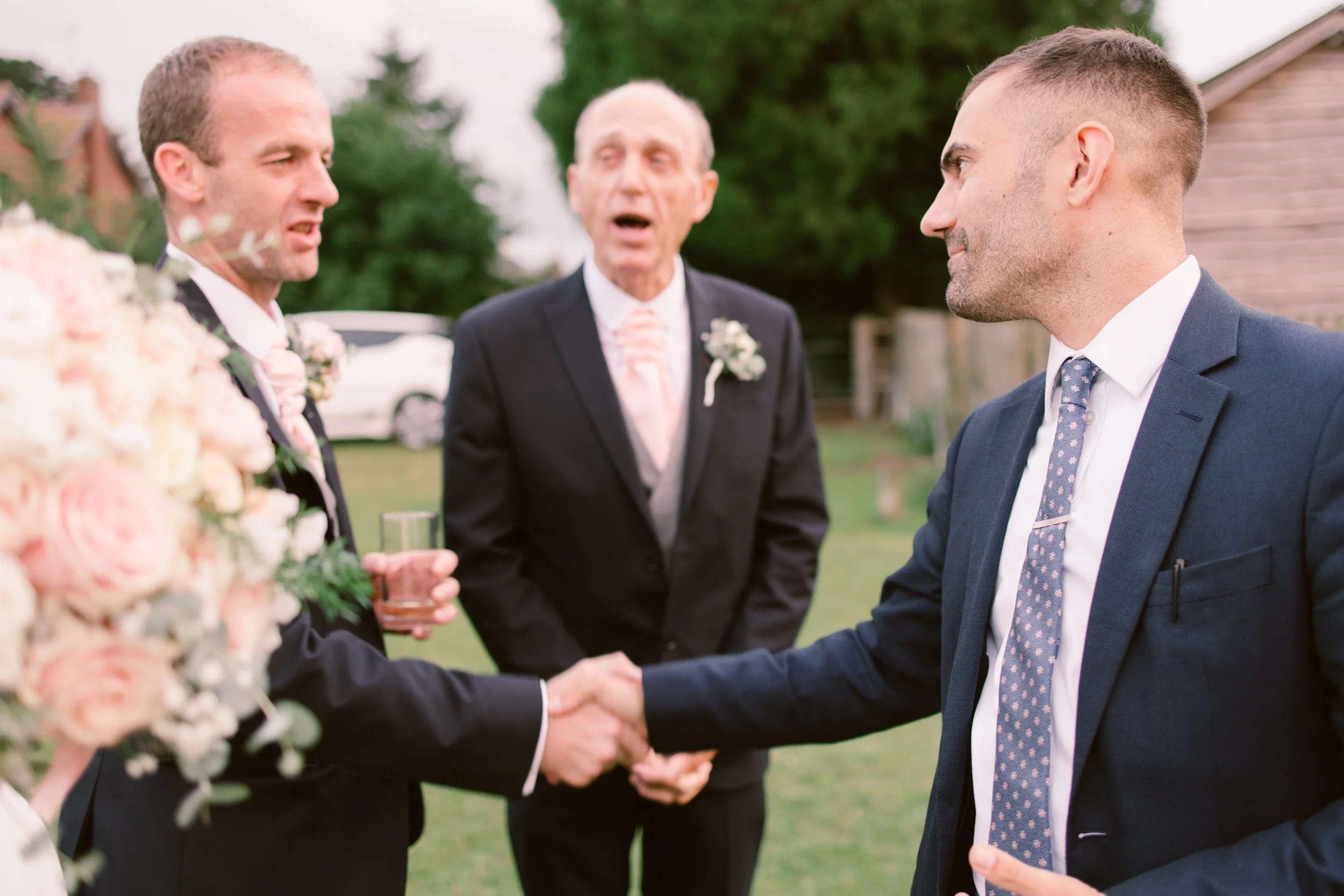
Magician shaking hands with the groom — illustrating the range of supportive roles that come together to make a wedding day run smoothly.
Every wedding has a cast of characters, and it isn't always obvious who is supposed to be doing what. Couples planning their first wedding — which, by definition, is most couples — are often surprised by how many distinct roles there actually are, how much overlap there can be between them, and how much smoother the day runs when everyone genuinely understands their job in advance. This guide walks through every key role at a typical UK wedding, what each person is actually responsible for, and how to make sure nothing falls through the gaps between them.
The couple
It sounds obvious, but it's worth saying clearly: the bride and groom (or the couple, in whatever combination applies) are not meant to be managing logistics on their wedding day. Every other role on this list exists, in one way or another, to free the couple from exactly that responsibility. If you find yourselves fielding questions about table plans or chasing the caterer during your own reception, something in the planning has gone wrong — and the fix is almost always better delegation of the roles below, not more effort from you on the day itself.
The best man
The best man's role traditionally centres on supporting the groom — historically through the practicalities of getting him to the ceremony on time, and in the modern wedding, through a broader set of responsibilities that usually include organising the stag do, looking after the rings until the ceremony, giving a speech, and acting as an informal point of contact for the groomsmen. On the day itself, the best man is often called upon for small but important tasks: holding the rings safely, making sure the groom's outfit and transport are sorted, and occasionally being roped into impromptu problem-solving if something unexpected comes up. The best speeches tend to come from best men who have spent real time on them in advance rather than improvising on the day — a useful thing to mention gently if you know yours leaves things to the last minute.
The maid of honour (or matron of honour)
The maid of honour is the bride's equivalent of the best man — chief bridesmaid, principal support, and often the person managing the rest of the bridal party. Typical responsibilities include helping organise the hen do, assisting with dress shopping and fittings, helping the bride get ready on the morning of the wedding, holding the bouquet during the ceremony, and frequently giving a speech alongside or instead of the traditional father-of-the-bride toast. On the day, the maid of honour is often the person quietly managing small emergencies — a loose hem, a forgotten lipstick, a moment of pre-ceremony nerves — that the bride never needs to know about.
Bridesmaids and groomsmen
Beyond the maid of honour and best man, bridesmaids and groomsmen play a supporting role throughout the day — helping with practical tasks, supporting the couple emotionally, and generally being present and available wherever they're needed. Their formal duties are usually lighter than those of the chief bridesmaid or best man, but a good bridal party works as a team, picking up whatever needs doing without waiting to be asked.
The officiant or celebrant
The person who actually marries you — a registrar, a vicar or other religious minister, or an independent celebrant for a non-legally-binding ceremony — is responsible for the legal and ceremonial heart of the day. Their role is to guide the couple and guests through the vows, ensure all legal requirements are correctly met (for legally binding ceremonies), and set the tone for the formal part of the proceedings. Increasingly, couples are choosing independent celebrants specifically because they allow for a more personalised, less rigidly scripted ceremony — something worth exploring if a fully bespoke ceremony matters to you, since registrars and most religious officiants work within fixed formats.
The wedding planner or coordinator
Not every wedding has a dedicated planner, but for those that do, this role sits above almost everyone else on this list in terms of overall responsibility. A wedding planner manages the months of preparation before the day — sourcing and liaising with suppliers, building the running order, managing the budget, and troubleshooting problems long before they become visible to anyone else. On the day itself, a planner (or an on-the-day coordinator, a lighter-touch version of the same role) becomes the central point of contact for every supplier, handling anything that goes wrong quietly and efficiently so that nobody else has to think about it. If your budget allows for only one piece of additional professional support beyond the obvious suppliers, an on-the-day coordinator is consistently the highest-value addition — they are the person making sure every other role on this list actually does what it's supposed to, at the right time.
The venue coordinator
Distinct from a wedding planner, the venue's own coordinator is responsible specifically for everything happening within their building or grounds — room turnarounds, catering logistics if catering is in-house, staffing, and making sure the venue itself runs smoothly. A good venue coordinator works closely with your wedding planner (if you have one) or directly with you, and it's worth having a clear conversation in advance about where the venue coordinator's responsibilities end and where yours, your planner's, or your host's begin — overlapping assumptions here are one of the most common sources of small but avoidable confusion on the day.
The photographer and videographer
Beyond the obvious job of capturing the day, a good wedding photographer also plays a quiet logistical role — managing the timing of formal photographs, keeping the wedding party gently on schedule during the photo session, and working closely with whoever is hosting the day to ensure the gap between ceremony and reception doesn't run long. Couples sometimes underestimate how much influence a photographer has over the pace of the afternoon; choosing one who is experienced, calm, and good at managing groups of people is worth as much attention as their portfolio.
The DJ or band
Responsible for the evening's music, a DJ or band's core job is straightforward, but the best ones bring genuine skill in reading a room — building energy at the right moments, knowing when to bring the tempo down, and keeping a dance floor full for hours rather than just playing songs in sequence. As covered in more detail elsewhere, many DJs also take on basic hosting and announcement duties as part of their package, which can work well but is worth confirming explicitly rather than assuming.
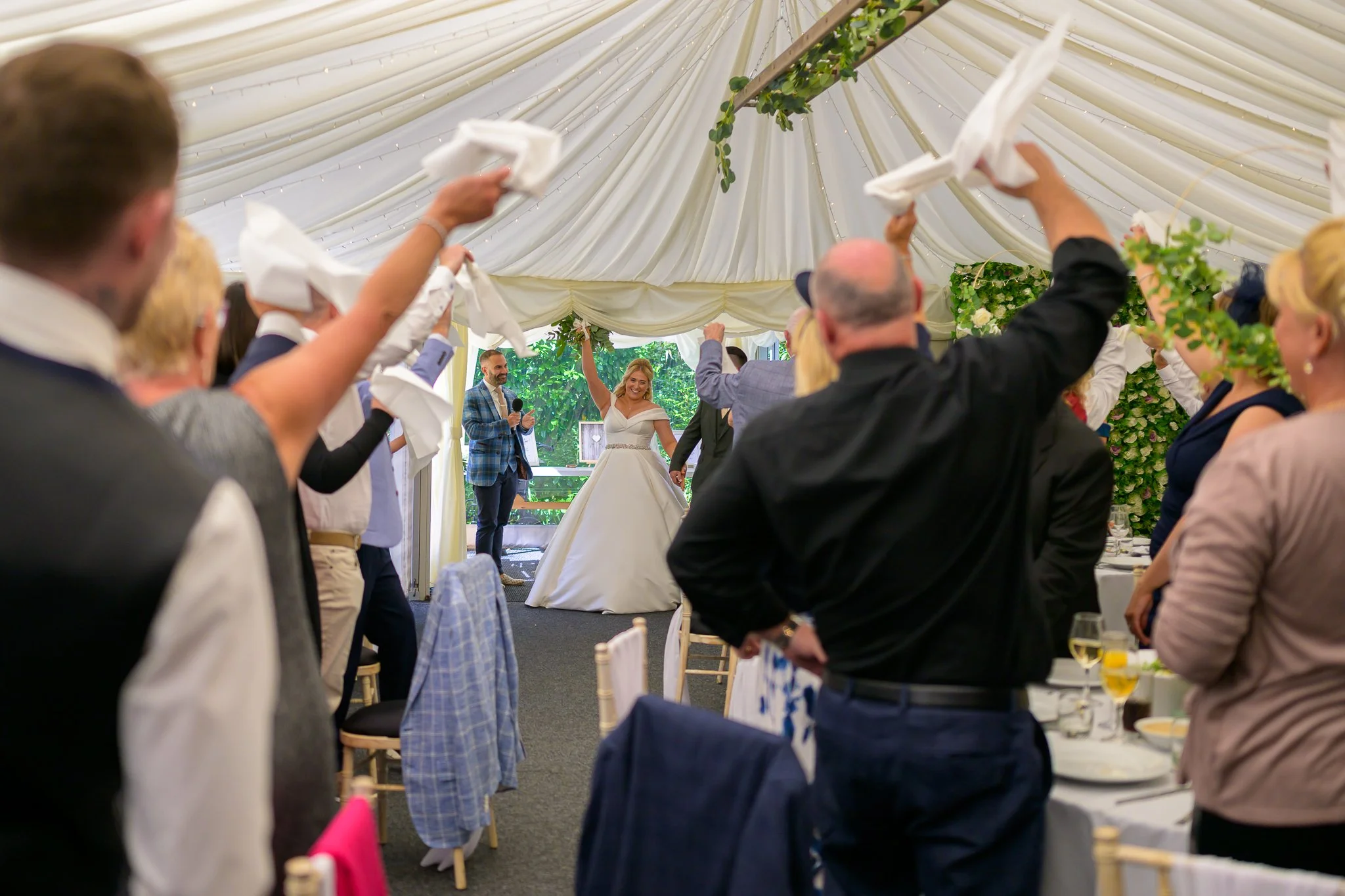
A wedding host guiding guests through a key moment of the day — the kind of seamless transition that defines a well-hosted wedding.
The wedding host or master of ceremonies (MC)
This is the role most couples underestimate until they've either experienced a wedding with a brilliant host or sat through one without any clear hosting at all — and the difference between the two is considerable. A wedding host is responsible for guiding the day's key transitions: welcoming guests, announcing when photos are starting, calling everyone through for the wedding breakfast, announcing the couple's entrance into the room, introducing speeches, and cueing the first dance. Done well, this role is largely invisible — guests simply experience a day that flows effortlessly from one moment to the next. Done badly, or left to nobody in particular, the day can drift: awkward silences before announcements, confusion about when to sit down, speeches that start without anyone really knowing whose turn it is.
Traditionally this job fell to the best man, the venue's events manager, or whoever happened to be holding a microphone at the right moment. Increasingly, couples are choosing to book a dedicated professional host — sometimes a standalone MC, sometimes (as is increasingly popular) someone who combines hosting with entertainment, such as a magician who performs close-up magic for guests throughout the afternoon and then steps into the formal hosting role for the announcements and speeches. The advantage of this combined approach is that your host arrives already known and liked by your guests, having spent the early part of the day creating genuine warmth and connection — which makes every subsequent announcement land more naturally than it would coming from a stranger picking up a microphone for the first time.
Parents and family
Parents of the couple often carry informal but significant responsibilities — financial contributions in many cases, a speech (traditionally the father of the bride, though this has loosened considerably in recent years), and a general sense of hosting duty toward their side of the guest list. It's worth having an honest conversation early in the planning process about what role each set of parents expects to play, since assumptions here can occasionally cause friction that has nothing to do with the wedding itself and everything to do with family dynamics that predate it by decades.
Ushers
Often overlooked in early planning, ushers are responsible for showing guests to their seats at the ceremony, handing out order of service sheets, and generally making sure guests feel looked after as they arrive. It's a small role with a disproportionately large impact on first impressions — guests who are warmly and efficiently shown to their seats start the day feeling looked after, while a ceremony that begins with confused milling about in a car park does not.
Making sure nothing falls through the gaps
The single most common planning mistake across all of these roles isn't choosing the wrong person for any individual job — it's assuming that the gaps between roles will sort themselves out. Who announces that the speeches are starting if your best man is also giving one? Who tells the band when to start playing the first dance music if your venue coordinator has gone off to manage the catering? Who steps in if the photographer is running behind and the wedding breakfast needs to be delayed?
The honest answer is that these gaps need a single point of accountability, and that's precisely the role a dedicated wedding host fills most reliably. Rather than hoping that several well-meaning people will collectively keep the day on track, a professional host takes explicit ownership of the transitions — which is exactly why this is one of the roles most worth investing in properly, even on a tight budget.
If you'd like to find out more about a wedding host who also brings genuine magic to your day, visit my weddings page.
Trying to work out who should be hosting your wedding day? Get in touch — I'd love to talk through what's possible for your celebration.
Want your wedding day to run seamlessly from start to finish? Get in touch to discuss hosting and entertainment for your day.