
What is the Magic Circle and Why Does it Matter When Hiring a Magician?

A top-down photograph of the iconic spiral staircase inside the Magic Circle headquarters in London. The staircase features oak wooden treads, a curved handrail, and oval silver metal balusters that spiral downward in a hypnotic pattern. At the base, a black and white chequerboard floor is visible with a small circular medallion at the centre.
If you've spent any time looking for a professional magician — for a corporate event, a wedding, or any other occasion — you'll have noticed the words "Magic Circle member" on more than a few websites. It appears in biographies, on credentials pages, and in the marketing materials of performers across the country. But what does it actually mean? Is it a meaningful professional credential or simply a piece of marketing language? Should it genuinely influence your decision about who to book? The short answer is yes — and understanding why reveals something important about how the market for professional magic actually works, and how to navigate it with confidence.
A brief history of the Magic Circle
The Magic Circle is the world's most prestigious and longest-established magic society. It was founded in London in 1905 by twenty-three magicians who gathered at a café near the Strand with the intention of forming an organisation that would uphold the standards of magic as a performing art, protect the craft's secrets, and create a professional community of serious practitioners. From those modest beginnings, the Magic Circle grew into an institution with members across the globe, a permanent headquarters in central London, and a history stretching across more than a century of performing arts culture.
The Magic Circle's founding in the Edwardian era was not accidental. The early twentieth century was a period in which the performing arts were undergoing significant professionalisation across every discipline — theatre, music, dance — and magicians of serious intent wanted to be part of that movement. The organisation's founders wanted to distinguish themselves from the itinerant street performers and fairground entertainers with whom they were too often confused, and to establish magic as a craft discipline worthy of the same respect as other performing arts. They succeeded in ways they could not have anticipated: the Magic Circle became the global benchmark for professional excellence in the field, and it retains that position to this day.
The organisation's motto — "Indocilis privata loqui," Latin for "not apt to disclose secrets" — speaks to the discretion and professional commitment that membership demands. It is a motto that has particular relevance for corporate and private event magicians, for whom professional discretion is as important as technical skill.
What does Magic Circle membership actually require?
This is the most important thing to understand about the credential: Magic Circle membership is not self-declared, purchased, or automatic. It is earned through a rigorous process of application and audition before a panel of experienced senior members. Candidates must demonstrate technical skill across a range of sleight-of-hand disciplines, performance ability in front of a live audience, a genuine knowledge of the history and theory of magic, and a commitment to the craft as a serious performing art rather than a casual hobby. A significant proportion of applicants are rejected, and those who pass do so on merit.
This independent assessment is precisely what gives Magic Circle membership its value as a professional credential. In a market where anyone can describe themselves as a professional magician — there is no regulatory body, no licensing requirement, and no qualification that must be obtained before performing for paying clients — the Magic Circle provides what the market otherwise lacks: a rigorous, peer-assessed, independently maintained standard that has been upheld consistently for over a century. When you see Magic Circle membership on a performer's profile, you are seeing a credential that has been awarded by their peers, not claimed by themselves. That distinction matters considerably when you are making a significant booking commitment for an important event.
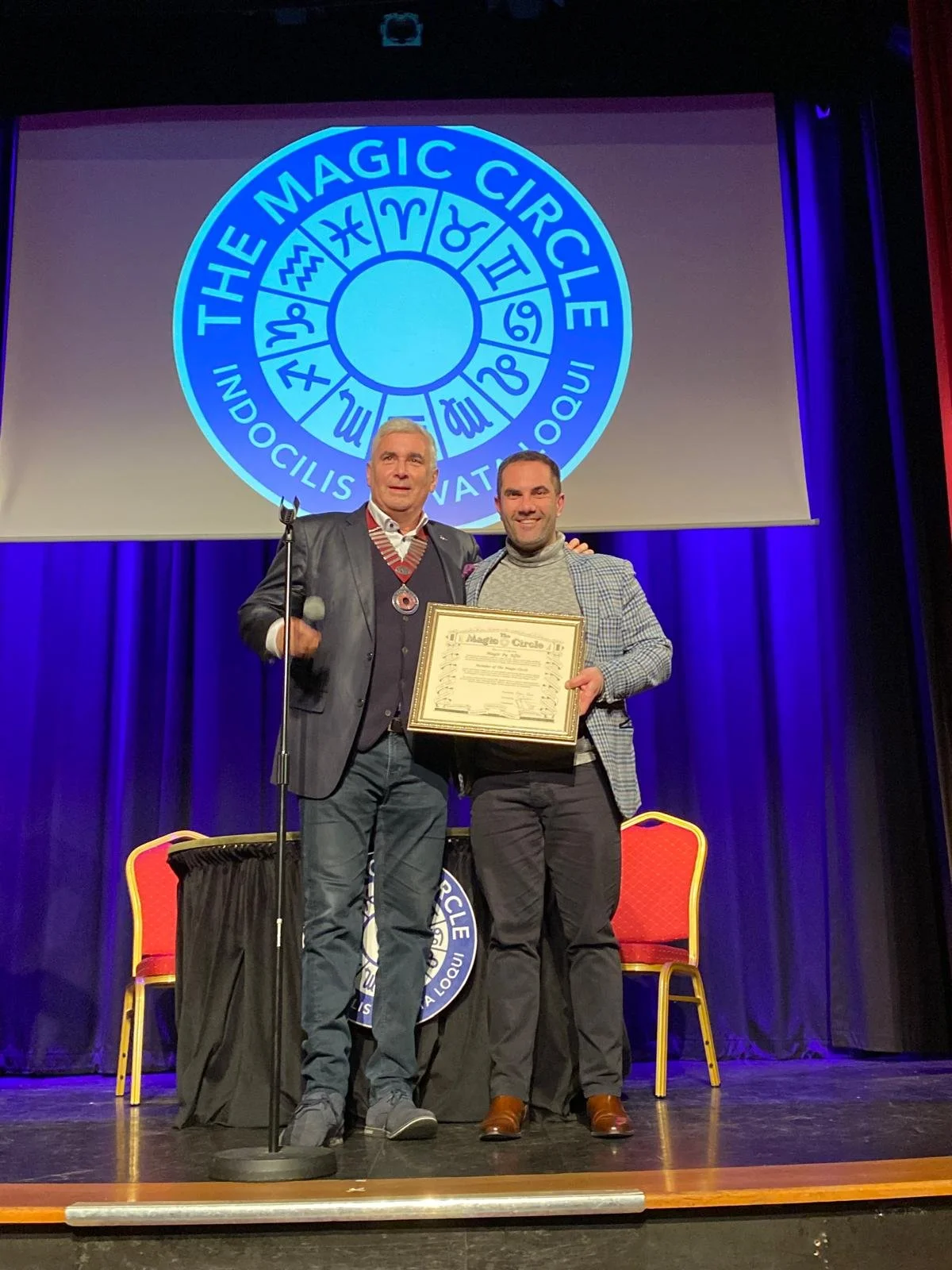
Magic by Alfie receives his Magic Circle membership certificate on stage from Marvin Berglas, President of the Magic Circle. The two stand in front of the iconic Magic Circle logo, with Alfie holding the framed certificate. The stage is lit with purple and blue lighting.
Why credentials matter more than you might expect
When you hire any professional for an important occasion — a solicitor, a surgeon, an architect — you rely partly on credentials because you lack the technical expertise to assess quality yourself. The same logic applies to booking a magician, and it applies more powerfully than most people initially assume. Watching a performance online does not give you the technical knowledge to assess whether the sleight of hand is genuinely flawless or merely adequate to an untrained eye. A polished showreel does not tell you whether the performer has the interpersonal intelligence to work a room full of senior corporate professionals, or the emotional sensitivity to navigate the complex social dynamics of a wedding. The technical and professional qualities that make the difference between a genuinely exceptional performance and a disappointing one are largely invisible to anyone without specialist knowledge.
Magic Circle membership closes this gap. It provides an expert assessment — carried out by people who do have the technical and professional knowledge — of whether a performer meets a genuine standard of excellence. It does not guarantee a perfect performance for your specific occasion, but it significantly narrows the field to performers who have been independently validated and who take their craft seriously enough to seek that validation.
For corporate events, weddings, and high-profile private occasions where the entertainment reflects directly on the host and where a poor experience has real consequences — for the reputation of the company, for the strength of the client relationships involved, for the memory of the wedding day — this independent validation is not a luxury consideration. It is one of the most practical and reliable tools available for making a confident booking decision in an unregulated market.

A wedding magician performs close-up magic for a bride and groom in a rustic barn venue strung with fairy lights. The bride, holding a vibrant bouquet of pink, coral and red flowers, laughs with delight while the groom looks on in wide-eyed astonishment. The magician, seen from behind in a distinctive checked blazer, holds a playing card as the trick unfolds.
Magic Circle credentials in context: what else to look for
It is worth being clear that Magic Circle membership, while valuable, should be considered alongside other indicators of quality rather than treated as a sufficient criterion on its own. A performer might hold associate membership while lacking the specific experience, interpersonal confidence, or performance instincts required for a particular type of event. A corporate dinner for two hundred senior professionals makes different demands from a wedding reception for mixed-age family guests, which makes different demands from a trade show floor — and no single credential validates a performer across all of these contexts simultaneously.
This is why credentials should always be combined with specific relevant experience. Ask not just whether a performer is a Magic Circle member, but whether they have documented experience at events comparable to yours in scale, format, audience profile, and level of formality. Ask for footage of real performances in the specific context you are booking. Read testimonials from clients at similar events. These layers of evidence, taken together with the assurance of professional credentials, give you the most complete and reliable picture available.
Verifying Magic Circle membership
The Magic Circle maintains a directory of its members, and membership claims can be independently verified. If a performer claims Magic Circle membership — there is no reason not to confirm it. A genuine member will welcome the question and be able to confirm their membership status clearly, accurately, and with confidence. Any hesitation, vagueness, or unwillingness to engage with a verification request should be treated as a signal worth taking seriously.
Beyond simple verification, it is worth asking a performer about their Magic Circle journey — when they joined, at what grade, what the audition and assessment process involved, and how their standing within the organisation has developed since they first joined. These questions reveal not just the substance of the credential but a performer's relationship to their own craft and their investment in ongoing professional development. A performer who can answer these questions in detail, with genuine enthusiasm and without deflection, is one whose professional credentials are as solid as they appear.
To find out more about the credentials behind these performances, visit my about page.
If you'd like to discuss what Magic Circle credentials mean in practice for your specific event, get in touch — I'm always happy to have an open conversation about professional standards before any commitment is made.
Interested in booking a Magic Circle magician for your event? Get in touch to check availability.